The safest way to scale Facebook lead ads is not to move the budget slider and hope the algorithm finds more of the same people. It is to create a controlled system: prove the economics, choose the right scaling route, make one meaningful change at a time, give delivery enough room to adapt, and judge success using qualified leads and booked calls — not raw lead volume alone.
This guide shows how to build that system as your monthly ad budget moves from $500 to $10,000. The figures refer to ad spend, not agency management fees or total marketing costs. Your correct budget and guardrails depend on your offer, market, conversion rate, sales capacity, and customer economics.
This guide is built around how to scale Facebook lead ads without increasing CPL — specifically for service businesses using Meta for lead generation, not ecommerce ROAS. The frameworks here are original Growthbay systems, not universal Meta guarantees.
→ The short answer: scale the system, not just the budget
Before you increase spend, confirm four things:
- The offer converts. People understand what they get and why they should act now.
- The tracking is trustworthy. Leads, qualified leads, booked calls, and sales can be tied back to the campaign, ad set, and ad.
- The business can handle more demand. A campaign cannot create profitable growth if the sales team replies slowly or cannot serve the extra customers.
- The economics leave room to scale. Your acceptable cost per lead is based on profit and conversion rates, not on an arbitrary benchmark.
Meta's own documentation says the impact of a budget change depends on its magnitude. Its example contrasts a small change from $100 to $101 — which is unlikely to restart learning — with a much larger change from $100 to $1,000, which may. Meta does not publish a universal "increase your budget by exactly 20%" rule. Many practitioners use gradual 10–20% increases as a risk-management heuristic. That can be a reasonable starting point, but it is not a platform guarantee. Treat the percentage as a test design choice, not a law.
1 Prove the economics before scaling
A low CPL is not automatically a good result. A $10 lead that never answers the phone can be less valuable than a $35 lead that books a sales call. Track these numbers together:
- CPL: ad spend divided by total leads.
- Qualification rate: qualified leads divided by total leads.
- CPQL: ad spend divided by qualified leads.
- Booked-call rate: booked calls divided by qualified leads.
- Show rate: attended calls divided by booked calls.
- Close rate: new customers divided by attended calls.
- CAC: total acquisition cost divided by new customers.
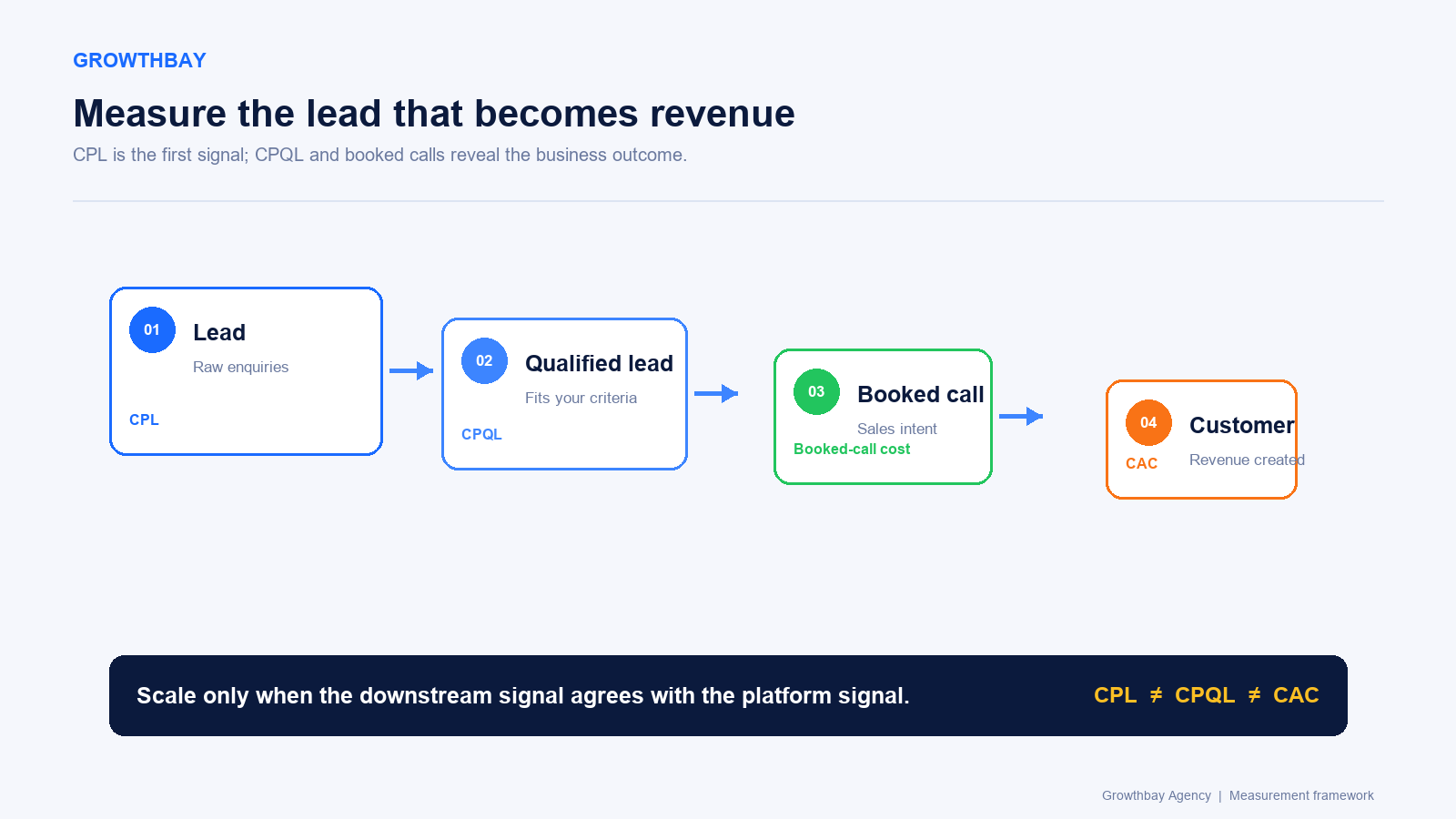
Use your own gross-profit math to set a ceiling. For example:
Average gross profit per customer: $2,000
Raw lead-to-customer rate: 5%
Share of gross profit willing to allocate to ads: 50%
These are examples, not benchmarks. Replace them with your actual numbers. If 40% of raw leads become qualified and qualified leads close at 12.5%, the illustrative maximum CPQL would be $2,000 × 12.5% × 50% = $125.
A campaign is ready to scale when its economics are understandable, the lead quality is stable, and the business can respond to more enquiries. If you do not know your qualification rate or close rate, your first scaling action should be measurement — not more spend.
2 Use a $500-to-$10,000 budget ladder
The table below turns a large jump into smaller operating stages. This Meta Ads scaling strategy for small business uses monthly amounts with a 30-day planning month for daily equivalents.

| Monthly ad budget | Approx. daily budget | Main job at this stage | Readiness gate |
|---|---|---|---|
| $500 | $16.67/day | Validate the offer, tracking, audience, and creative angles | Baseline CPL and lead-quality data are available |
| $1,000 | $33.33/day | Increase volume without changing the whole account | CPQL and qualification rate remain within target |
| $2,500 | $83.33/day | Add creative and audience depth | The account has a repeatable testing process |
| $5,000 | $166.67/day | Expand the funnel and improve downstream measurement | CRM stages and sales feedback are connected |
| $10,000 | $333.33/day | Operate a repeatable growth system | Creative supply, sales capacity, and marginal economics are healthy |
At $500 per month: establish a clean baseline
Keep the structure simple. Start with one clear acquisition objective, a small number of strong creative concepts, and a conversion path that you can measure. At this stage, focus on one primary offer and one clear conversion event, two to four meaningfully different creative concepts, a lead form or landing page with enough qualification to protect sales time, and UTMs with a CRM field for campaign, ad set, ad, and lead status.
At $1,000 per month: make the first controlled increase
Increase the budget only when the baseline meets your economic target. Keep the offer and tracking stable while you test the budget change. Record the pre-change CPL, CPQL, qualification rate, and booked-call rate so you can compare like with like. Avoid changing the budget, audience, optimization event, landing page, and creative all at once — if performance changes, you will not know which decision caused it.
At $2,500 per month: add horizontal depth
Once the original campaign has enough room to spend, scaling can come from more than budget. Add new creative concepts, test a different hook, widen an appropriate audience signal, or introduce a new placement or conversion path. A useful test question is: "What new source of qualified demand are we adding?" The answer should be a different message, audience opportunity, placement, or funnel step — not simply a duplicate with a new name.
At $5,000 per month: connect advertising to the CRM
Raw lead reporting becomes less useful as volume rises. The campaign needs feedback from the sales process: contacted, qualified, booked, attended, won, lost, and revenue. This is where Meta Ads lead quality optimization becomes the primary lever. Meta's current lead-generation guidance emphasizes first-party data and CRM connections for optimizing toward qualified leads.
At $10,000 per month: manage marginal economics and capacity
At this level, do not assume that doubling the budget will double the number of good leads at the same cost. The auction may move into more expensive opportunities, creative fatigue can appear faster, and the sales team may become the bottleneck. Create a weekly operating view that includes spend and delivery by campaign, marginal CPL and CPQL after each budget change, qualification and booked-call rates, creative-level performance and fatigue signals, speed-to-lead and sales capacity, and gross profit or expected customer value — not just platform-reported ROAS.
3 Choose vertical or horizontal scaling
Vertical scaling means increasing budget on a campaign or ad set that is already working. Use it when the offer, tracking, creative, audience, and downstream quality are healthy.
Horizontal scaling means adding new sources of demand: new creative concepts, audience signals, placements, geographies, landing pages, or funnel stages. Use it when the existing campaign is constrained by audience depth, creative fatigue, or limited conversion volume.

Use this decision logic for vertical vs horizontal scaling Meta Ads:
- CPL and CPQL are within target, quality is stable, and delivery has room: test a controlled vertical increase.
- CPM is rising, CTR is falling, and frequency is increasing: refresh the creative and review audience depth before adding more budget.
- CTR is healthy but landing-page or form conversion is falling: fix the page, form, offer, or mobile experience.
- Raw CPL is stable but qualified-lead rate is falling: improve qualification, targeting, creative promise, or CRM feedback. Do not call this a successful scale.
- Leads are increasing but booked calls are not: inspect response time, follow-up, calendar availability, and sales qualification.
4 Protect the learning phase when changing budgets
Meta describes the learning phase as the delivery system exploring how to deliver an ad set. It recommends avoiding unnecessary edits, unrealistic budgets, excessive ad-set volume, and frequent changes that push delivery back into learning. Meta also says an ad set usually needs about 50 optimization events in the week after its last significant edit to exit learning — though actual results depend on the account and optimization event.
Use this controlled-change protocol for Facebook ads budget increase without resetting learning phase:
- Capture a baseline. Record at least CPL, CPQL, qualification rate, booked-call rate, spend, and conversion volume.
- Choose one main change. A budget increase, a new creative concept, or an audience expansion should be distinguishable.
- Avoid a magic waiting period. Give the account enough delivery to evaluate the change; the right window depends on conversion volume and sales-cycle length.
- Monitor downstream results. Check CRM quality, not just the first platform event.
- Predefine a rollback rule. If CPQL moves materially above your target after sufficient delivery and qualification rate declines, return to the prior configuration and investigate.
Your rollback thresholds are business guardrails, not Meta rules. Write them down before making the change so a short-term spike does not trigger a panic edit — or a persistent decline gets ignored.
5 Scale lead quality, not just lead volume
Lead quality often drops when the ad promise becomes broader than the service. Protect it with a connected feedback loop:
Improve the promise
Make the ad specific about the customer, problem, geography, service, and next step. "Get more leads" is broad. "Get a 30-minute paid-social account review for your local service business" gives the prospect a clearer reason to respond.
Ask useful qualification questions
Add only questions that change sales handling or campaign learning. Depending on the business, that may include service needed, location, approximate budget, timeline, or current marketing channel. Every extra field can add friction — compare qualification rate and booked-call rate, not just form completion rate.
Send CRM signals back to the campaign
Track the full lead path: new lead, contacted, qualified, booked, showed, won, lost, and revenue. Preserve the Meta Lead ID where supported, keep source fields intact, and send status updates consistently. Meta recommends using Conversions API with CRM data for qualified-lead optimization under its current guidance for cost per quality lead Meta Ads.
Watch creative fatigue
Meta defines creative fatigue as repeated exposure to the same creative reducing engagement and increasing cost per result. There is no universal frequency number at which fatigue begins. For a service business, "materially different" can mean a different customer problem or hook, a process explanation instead of a testimonial, a founder or expert speaking instead of static graphics, a proof asset using real approved evidence, or a different offer or call to action. Do not count ten near-identical designs as ten new ideas.
6 Diagnose a CPL spike before changing everything
When CPL rises on your Facebook lead generation ads, locate the broken stage instead of immediately duplicating the campaign. This is the practical answer to how to scale Facebook ads without increasing cost per lead:
| What changed? | Likely bottleneck | First response |
|---|---|---|
| CPM up, CTR and CVR stable | Auction cost or audience depth | Review audience size, exclusions, placements, and marginal CPQL |
| CPM stable, CTR down | Creative fatigue or weaker message | Test materially different hooks and formats |
| CTR stable, form or landing-page CVR down | Page, form, offer, or mobile friction | Review load time, copy, form fields, and message match |
| Raw CPL stable, quality rate down | Promise, targeting, qualification, or CRM feedback | Audit lead stages and optimize for quality |
| Leads up, booked calls down | Response time, follow-up, calendar, or sales process | Check speed-to-lead and booking workflow |
| Results unstable after a major edit | Learning disruption or too many simultaneous changes | Hold structure steady, gather clean data, and use the rollback rule |
This is a diagnostic framework, not a promise that one metric always identifies one cause. Use it to form the next testable hypothesis — not to declare a diagnosis without data.
7 A practical 30-day scaling plan
The schedule below is a planning sequence for a Meta Ads scaling strategy for small business — not a guarantee that every account should be changed every few days.

- Days 1–3: Establish the baseline. Confirm events, UTMs, CRM fields, lead stages, sales response time, and the economic target. Document the current creative and audience structure.
- Days 4–10: Make one controlled improvement. Choose either a cautious budget increase or a meaningful creative/funnel test. Keep the other major variables stable.
- Days 11–17: Inspect quality. Compare CPL with CPQL, booked-call cost, lead status, and sales feedback. Look for fatigue, overlap, or delivery constraints.
- Days 18–24: Add horizontal depth. Introduce a genuinely different creative concept, audience opportunity, placement, or conversion path if the bottleneck supports it.
- Days 25–30: Decide the next stage. Scale again only if the marginal economics and lead quality support it. Otherwise, roll back, fix the constraint, and create a new test plan.
Every increase in spend should buy a learning opportunity, not just more of the same exposure. If you cannot describe what you are learning from a budget increase, you are not scaling — you are spending.
Want an expert review of your Meta Ads account?
Growthbay can review your campaigns, funnel, tracking setup, and lead-quality process to identify exactly where your scaling is breaking down — in a free 30-minute audit.
Frequently asked questions
Final takeaway
Scaling Meta Ads from $500 to $10,000 per month is a business operating challenge, not a single Ads Manager setting.
Build the foundation first. Measure qualified leads and booked calls. Use controlled vertical increases when the campaign is healthy, horizontal tests when the system needs more depth, and a rollback rule when the economics move outside your target. Most importantly, connect advertising data to the CRM so Meta and your team can learn from the leads that actually become customers.
Ready for an outside view of your campaigns?
Growthbay can review your Meta Ads account, funnel, tracking, and lead-quality process in a free 30-minute audit. We'll identify exactly what's holding your scaling back and what to fix first.