A high-performing 2026 digital marketing funnel has six planning stages — trigger, exploration, evaluation, conversion, retention, and advocacy — while recognizing that people loop between exploration and evaluation. Build the stages around customer questions, then measure movement with business outcomes rather than vanity metrics.
What is a digital marketing funnel?
A digital marketing funnel is a framework for mapping how people discover a brand, learn about an offer, compare alternatives, take a valuable action, and decide whether to return or recommend it. The framework helps you plan content, advertising, landing pages, sales follow-up, ecommerce experiences, and retention campaigns as one system.
The word "funnel" is useful because it forces prioritization. You can see where attention enters, where intent strengthens, and where revenue is lost. But it becomes misleading when it is treated as a rigid line. Google's research on the "messy middle" describes the period between a buying trigger and purchase as a loop between exploration and evaluation — based on literature reviews, observation studies, search-trend analysis, and a large experiment covering 310,000 simulated purchase scenarios.[1]
Use the funnel to organize decisions. Use journey data to understand behavior.
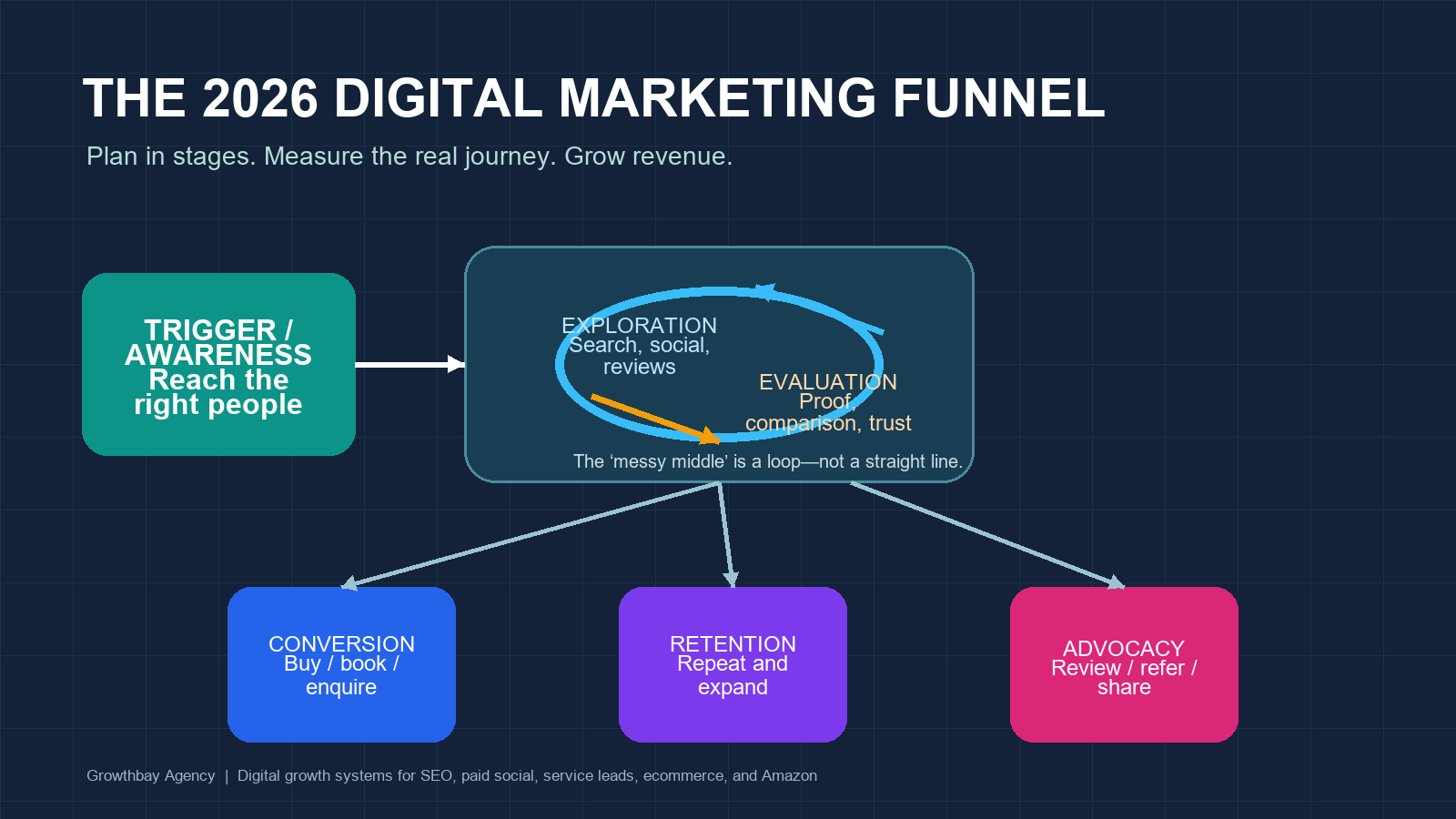
The six stages of a 2026 marketing funnel
Each stage maps to a specific customer question, the assets that answer it best, and the metrics that signal genuine progress — not just activity.
| Stage | Customer question | Useful assets | Metrics |
|---|---|---|---|
| 1. Trigger / awareness | "Is this relevant to me?" | Search content, short video, social proof, category education | Reach, view rate, CTR, branded search |
| 2. Exploration | "What options exist?" | Guides, comparisons, reviews, FAQs, marketplace discovery | Engaged sessions, content depth, email opt-ins |
| 3. Evaluation / intent | "Why this option?" | Case studies, proof, demos, pricing, product pages, retargeting | Qualified leads, PDP views, add-to-cart, demo rate |
| 4. Conversion | "Can I act with confidence?" | Clear offer, trust signals, checkout or booking flow | Revenue, close rate, CAC, ROAS, conversion rate |
| 5. Retention / expansion | "Was it worth it?" | Onboarding, email, replenishment, cross-sell, renewal | Repeat rate, LTV, margin, churn |
| 6. Advocacy | "Would I recommend it?" | Review requests, referrals, UGC, community, case studies | Referral rate, review volume, advocacy revenue |
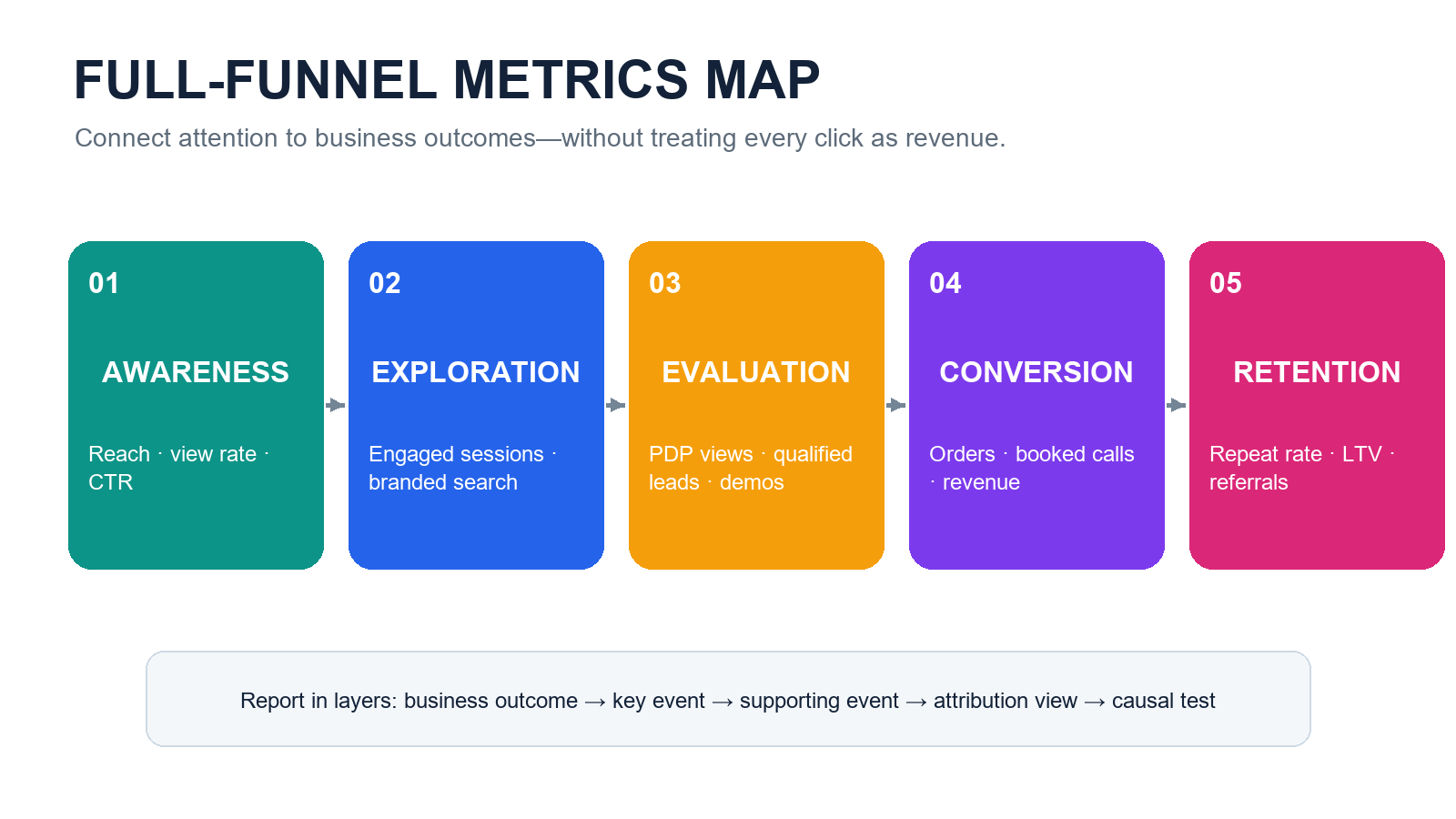
How to build a digital marketing funnel that earns revenue
1. Start with the business outcome, not the channel
Choose the outcome the funnel must improve: profitable revenue, qualified pipeline, booked appointments, repeat purchases, or retention. Then define the key event that signals meaningful progress. A page view or video view may help diagnose the journey, but it should not be treated as equivalent to a sale or a qualified opportunity.
- Ecommerce: contribution margin, purchases, repeat purchase rate, and customer lifetime value.
- Service businesses: qualified enquiries, booked appointments, show rate, close rate, and revenue per lead.
- Amazon sellers: profitable orders, new-to-brand sales, contribution margin, repeat purchase, and advertising efficiency.
- B2B or founder-led brands: qualified pipeline, sales-cycle velocity, win rate, and revenue attribution with clear caveats.
2. Match the message to the customer's question
Weak funnels ask cold audiences to buy before they understand the problem, or send high-intent visitors to pages that only repeat broad brand claims. Instead, map content to the question at each stage. Awareness content names the problem. Exploration content helps people understand the category. Evaluation content proves fit. Conversion content removes friction. Retention content makes the next purchase or renewal easier.
This is where the phrase "full-funnel marketing" becomes practical. It does not mean running every channel at once. It means that the promise, proof, landing page, follow-up, and measurement do not contradict one another.
3. Build one clear handoff between stages
Every stage needs a next action that is proportionate to intent. A first-time visitor may need a useful guide or comparison. Someone who has reviewed pricing, case studies, or product details may be ready for a call, checkout, or quote request. Make the handoff visible, reduce unnecessary choices, and preserve message continuity from the original search result or ad to the destination page.
4. Diagnose the leak before changing the budget
If traffic is rising but revenue is flat, buying more traffic may simply widen the leak. Compare stage-to-stage movement by device, audience, channel, landing page, product, location, and lead source. Look for the first meaningful break — not only the final conversion rate.

Four practical funnel models for different growth situations
A. Digital marketing funnel for a small business or founder
A founder-led funnel usually wins through clarity and follow-up rather than complexity. A useful path is: educational search or social content → focused service or offer page → proof and qualification → booked call or enquiry → fast response and nurture → closed business → review or referral. Keep the form short, state who the offer is for, show evidence that is relevant to the buyer, and track lead quality — not just lead volume.
For local and service businesses, connect the funnel to service-area pages, Google Business Profile activity, reviews, call tracking, and a response process. Our SEO quick wins guide covers practical foundations such as service pages, reviews, local signals, and page experience.
B. Ecommerce marketing funnel
An ecommerce funnel often looks like: category discovery → collection or product page → cart → checkout → delivery and onboarding → repeat purchase. The most important work is not always at the top of the funnel. Product information, reviews, delivery clarity, total cost, payment options, returns, and mobile usability determine whether interest becomes an order.
Baymard's current aggregate reports a 70.22% average documented cart-abandonment rate across 50 studies, while noting that abandonment has multiple causes — and that 42% of surveyed US shoppers had abandoned because they were "just browsing / not ready to buy."[7] Treat these as research findings and diagnostic prompts — not as a universal conversion benchmark. A smart ecommerce funnel separates intent problems from usability problems.
Some visitors need better education or a stronger offer. Others need clearer costs, fewer form fields, more trust, or a faster checkout. The fix depends on which problem you actually have — not which problem is easiest to address.
C. Digital marketing funnel for service businesses
A service-business funnel has a different conversion event from ecommerce. The goal may be a qualified enquiry, booked appointment, estimate, or sales conversation. The path can be: local search or paid social → service-specific page → proof, location, price context, and FAQs → form or call → speed-to-lead and qualification → booked appointment → attended appointment → closed work → review and referral.
Measure the economics after the form. A low-cost lead that never answers the phone is not a growth result. Track source, service, location, response time, qualification, booking, show rate, close rate, and revenue. Our Meta lead-ad scaling guide uses this lead-to-customer logic rather than treating raw lead count as the goal.
D. Amazon seller marketing funnel
An Amazon seller marketing funnel combines marketplace demand capture with retail readiness and post-purchase value. A useful structure is: category or product discovery → branded and non-branded consideration → retail-ready listing and detail-page evaluation → purchase → review, Subscribe & Save, repeat purchase, and cross-sell. External SEO, creator content, email, and paid social can contribute to discovery and demand, while Amazon Attribution can help connect eligible off-Amazon activity to marketplace outcomes.
Amazon Ads describes four broad stages — awareness, consideration, conversion, and loyalty — and pairs them with different measures: reach and completion rate at the top, detail-page views and new-to-brand indicators in consideration, and orders, conversion rate, ROAS, ACOS, or CAC near conversion.[10] Visit our Amazon services page for listing, A+ content, PPC, and Seller Central support.
The metrics that matter: attribution is not causality
A funnel dashboard can look precise while answering the wrong question. Attribution assigns credit to touchpoints; it does not automatically prove that the touchpoint caused the outcome. A retargeting ad may receive credit because it appeared near conversion, while the underlying demand was created by search, reviews, product quality, sales follow-up, or a prior brand interaction.
Use a measurement hierarchy:
GA4 Funnel Exploration can visualize step completion, drop-off, elapsed time, segment comparisons, and next actions; Path Exploration can reveal forward paths, backward paths, and loops.[5][6] Use those tools to find where behavior changes, then connect the findings to CRM, order, margin, and lead-quality data.
Google Ads' current measurement guidance recommends combining attribution, incrementality experiments, and marketing mix modeling.[9] In plain English: use attribution to understand the path, experiments to estimate causal impact where possible, and broader models to understand the whole business context.
Want Growthbay to audit your funnel?
We'll review where your current marketing system is losing attention before it becomes revenue — and show you the highest-confidence fix first.
SEO for the 2026 funnel: helpful content beats keyword stuffing
A funnel article should rank because it answers a real planning problem better than competing pages — not because it repeats "digital marketing funnel" in every paragraph. Google's people-first guidance emphasizes original information, analysis, experience, clear authorship, and satisfying the reader's goal. Google also states that it has no preferred word count.[2]
That changes how to use keywords. The primary phrase belongs in the title, URL, introduction, and a relevant heading. Mid-tail terms belong where they clarify a section. Long-tail terms should appear only when the article genuinely answers that query. Do not create separate paragraphs that say the same thing with slightly different keyword variants.
Google's current guidance for AI Overviews does not require special AI files or schema tricks. A page still needs to be crawlable, indexable, internally linked, useful, and supported by a strong page experience.[3] For image SEO, use descriptive filenames, standard HTML image elements, responsive behavior, and concise alt text that explains the image. Google specifically warns against stuffing alt attributes with keyword lists.[4]
LCP of 2.5 seconds or less · INP of 200 milliseconds or less · CLS of 0.1 or less. Field data is more representative of real users than lab data alone, and good scores do not guarantee top rankings.[8]
A practical 30-day implementation plan
You do not need a twelve-month transformation plan to improve a funnel. Start with one complete loop: define the outcome, baseline the journey, fix the clearest friction, test one hypothesis, and review what changed.

Frequently asked questions
Turn attention into a measurable growth system
The best digital marketing funnel is not the one with the most stages or the largest dashboard. It is the one that makes the next decision obvious. When awareness connects to useful exploration, exploration connects to credible evaluation, evaluation connects to a low-friction conversion, and the post-purchase experience earns retention and advocacy, marketing becomes easier to improve.
Growthbay helps brands connect SEO, paid social, service-business lead generation, ecommerce growth, and Amazon operations into revenue-focused systems. Book a free 30-minute audit to discuss your funnel, or explore the blog for more practical guides.
Ready to connect your funnel to revenue?
Growthbay builds digital marketing systems that turn attention into qualified leads, profitable orders, and repeat customers — for service businesses, ecommerce brands, and Amazon sellers.
Related articles
[1] Google, "Decoding the messy middle of purchase behavior" · [2] Google Search Central, "Creating helpful, reliable, people-first content" · [3] Google Search Central, "AI features and your website" · [4] Google Search Central, "Image SEO best practices" · [5] Google Analytics Help, "GA4 Funnel exploration" · [6] Google Analytics Help, "GA4 Path exploration" · [7] Baymard Institute, "50 Cart Abandonment Rate Statistics 2026" · [8] web.dev, "Web Vitals" · [9] Google Ads Help, "Measure your marketing performance" · [10] Amazon Ads, "What is a marketing funnel?"