
A potential customer clicks your ad, reads the first section of your landing page, opens two competitor tabs, checks a few reviews, gets distracted, comes back three days later, and still does not buy.
Most businesses call that a traffic problem. Often, it is a decision problem.
The buyer has not necessarily rejected your offer. They may still be comparing options, looking for proof, trying to understand the difference between providers, calculating risk, or waiting for a reason to act now. The space between the first trigger and the final purchase is where many marketing systems quietly lose revenue.
Google and The Behavioural Architects describe this space as the messy middle: a non-linear loop in which people move between exploration — expanding the options they are considering — and evaluation — narrowing those options down — until they feel confident enough to choose.[1]
That model matters because it changes the question. Instead of asking "How do we get more clicks?" you also need to ask:
"What does a buyer need to see, understand, and believe after the click before they can make a confident decision?"
This article explains how to answer that question without resorting to fake urgency, bloated funnels, or endless redesigns.
The customer journey is not a funnel with perfect timing
The traditional funnel is useful for organising work, but it can create a misleading picture of how people actually decide. It suggests that a prospect moves neatly from awareness to consideration to conversion. In reality, buyers loop.
A person might notice a problem or opportunity, search for possible solutions, compare providers, products, or approaches, return to search with a more specific question, ask someone they trust, revisit a page from a different device, delay because the risk feels unclear, and convert after one final piece of evidence removes the objection.
The messy-middle research tested purchase decisions using generic, unbranded websites across 31 product categories. It involved 31,000 in-market buyers and 310,000 simulated purchase decisions.[1] That does not mean every business should copy the experiment or expect a specific lift. It does show why a single landing page and a single conversion event rarely answer every question a buyer has.
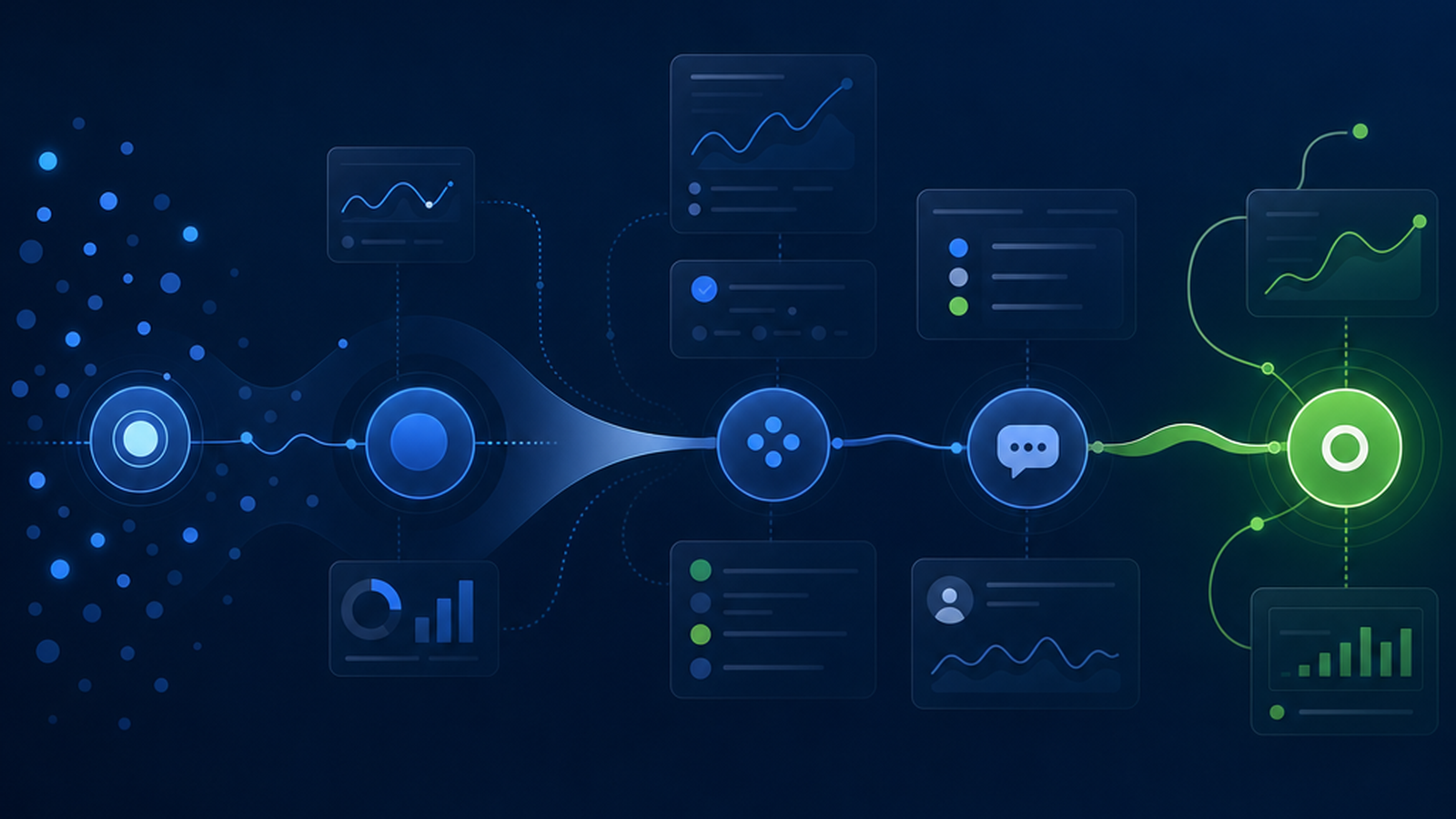
Your website has to support both modes:
- Exploration: "What are my options? What should I know? Which category or approach fits my situation?"
- Evaluation: "Which option is safest, clearest, best value, and most likely to produce the outcome I want?"
If your site only supports exploration, visitors learn but do not act. If it only supports evaluation, visitors may not yet understand why your offer belongs on their shortlist.

Why good traffic still fails to convert
A business can have relevant traffic and still produce weak results when the journey after the click is poorly designed.

1. The page explains the offer but not the decision
Many service pages list deliverables — SEO audits, content creation, ad management, Amazon listing optimisation, social media management. That is useful, but it is not always enough. The buyer also wants to know who the service is for, what changes after the work, how the process operates, what it costs, how long it takes, and what happens if the fit is wrong.
A page that describes your service is not automatically a page that helps someone choose it.
2. The proof is separated from the claim
If a headline promises growth but the proof is hidden on another page, the reader has to do the work of connecting the two. During the messy middle, extra effort creates opportunities for doubt. Put the relevant evidence close to the relevant promise:
- a case study beside a performance claim
- a process explanation beside a "how it works" statement
- a review or testimonial beside the objection it answers
- a clear scope and starting point beside the CTA
3. The website assumes one type of buyer
A founder looking for a first SEO engagement is not asking the same questions as an e-commerce operator scaling paid traffic. A local service business may care about qualified calls, while an Amazon seller may care about contribution margin, listing conversion, and inventory risk. When every visitor receives the same generic message, nobody gets enough context to feel understood.
4. Measurement stops at the first form fill
A form submission is important, but it is not the same as a qualified opportunity or a customer. Google's GA4 documentation includes recommended lifecycle events such as generate_lead, qualify_lead, working_lead, close_convert_lead, and close_unconvert_lead.[2] If you only measure the first form submission, you may optimise for cheap, low-quality leads while missing the pages, campaigns, and messages that produce revenue.
Build for the six forces that shape a decision
The messy-middle research identifies six behavioural principles that can influence how people choose. Used responsibly, they help you make useful information easier to process. Used carelessly, they become manipulation.

Create two content systems, not one giant page
Your website should help people explore and evaluate without forcing every question into a single overloaded landing page.
Exploration content answers: "What should I know?"
Useful exploration assets include category guides, problem-based articles, "how to choose" explainers, glossary pages, trend analysis, checklists, educational videos, and comparison frameworks. The job of exploration content is to earn attention and shape the buyer's understanding of the problem. It should not hide the commercial next step, but it does not need to push a hard sale in every paragraph.
Evaluation content answers: "Which option should I choose?"
Useful evaluation assets include service pages, pricing or starting-point guidance, case studies, product comparison pages, FAQs, implementation timelines, returns, delivery or cancellation policies, demos and consultation pages, and proof of process and expertise. The job of evaluation content is to make the decision feel safer and more concrete.
Connect the two with specific next steps
Do not send every visitor to a generic "Contact Us" button. Match the next step to the question being answered:
- An educational SEO article can link to a technical SEO service page.
- A Meta Ads guide can link to campaign management or a free audit.
- An Amazon product-research article can link to Amazon growth services.
- A case study can link to a consultation with the same type of business.
The CTA should feel like the next logical move, not a change of subject.
Search visibility in the age of AI answers
Some businesses respond to AI search by chasing special markup, hidden files, or a new "AI SEO" trick. Google's current guidance says there are no additional technical requirements or special optimisations needed to appear in AI Overviews or AI Mode. Pages still need to be indexed, eligible to show a normal search snippet, and aligned with standard SEO and helpful-content best practices.[3]
That does not make content strategy irrelevant. It makes the fundamentals more important: answer the real question clearly, demonstrate first-hand knowledge where possible, organise information so it can be understood in context, support claims with credible sources, keep important content accessible to search engines and people, and measure whether search visitors engage and convert.
The winning content is not the content that tries to sound like an answer engine. It is the content that gives a useful answer, earns trust, and makes the next decision easier.
Use first-party data to make the next interaction more relevant
The messy middle becomes harder when every visitor receives the same generic follow-up. If someone has already read your pricing page, downloaded a checklist, or started a consultation request, the next message should reflect that context — subject to clear consent and sensible privacy practices.
A March 2025 Think with Google article summarised an Australian study of 2,500 in-market purchasers conducted in October 2024. In the experiment, first-party data and behavioural principles helped an invented challenger capture as much as 43% of preference in the tested scenarios.[4] That is not a promise that personalisation will produce a 43% lift for your business. It is a useful reminder that relevance can change which brand makes the shortlist.
Use first-party data to answer questions such as: which problem did the visitor show interest in, which page or product category did they evaluate, what information have they already received, what is the most helpful next step, and has the person already converted or asked not to be contacted? Personalisation should reduce repetition and improve relevance — not make the visitor feel watched.
Remove technical friction before spending more on traffic
A buyer cannot evaluate an offer smoothly if the page is slow, jumps around, or makes basic interactions frustrating.

The current Core Web Vitals "good" thresholds are: Largest Contentful Paint (LCP) of 2.5 seconds or less, Interaction to Next Paint (INP) of 200 milliseconds or less, and Cumulative Layout Shift (CLS) of 0.1 or less. These thresholds are assessed at the 75th percentile of page loads.[5][6][7]
The 2024 Web Almanac found that images were the LCP element on 73% of mobile pages, while 35% of mobile sites did not have a statically discoverable LCP element in the initial HTML. It also found that 16% of mobile sites lazy-loaded image-based LCP elements, which can delay the most important visual on the page.[8]
For a practical pre-campaign check:
- Identify the main visual or text block users should see first and make sure it is discoverable in the initial page HTML.
- Do not lazy-load the image that is responsible for LCP.
- Reserve space for images, banners, and embeds to prevent layout shifts.
- Test forms, menus, filters, and checkout interactions on real mobile devices.
- Review field data, not only a perfect desktop lab score.
It affects whether the buyer can get to the evidence that was supposed to build confidence. Fix technical friction before buying more traffic to drive into it.
For e-commerce: do not treat cart abandonment as one diagnosis
Baymard's published average cart-abandonment benchmark is 70.22%, calculated from 50 different studies and listed as updated on September 22, 2025.[9] That number is a benchmark, not an explanation. It combines different markets, devices, products, prices, and buyer intents. Your own data still matters more.
When an e-commerce customer abandons, separate the possible causes: the total cost was higher than expected, delivery timing was unclear, the shopper was only researching, the site required an account too early, the payment method was unavailable, a form or validation error blocked progress, the buyer did not trust the site enough to complete the purchase, or the product page answered interest but not risk.
Start with the simplest fixes: show total cost and delivery expectations early, support appropriate payment methods, allow a sensible guest path, make errors specific, and place returns and customer support information where the buyer needs it. For an Amazon seller, the equivalent work happens across the listing: main-image clarity, benefit hierarchy, review quality, variation logic, A+ content, price positioning, delivery promise, and post-click alignment from ads.
Want Growthbay to find where your decision journey is leaking?
We'll review your landing pages, conversion path, proof, and tracking in a free 30-minute audit — and tell you the highest-confidence fix to make first.
Track the journey, not just the last click
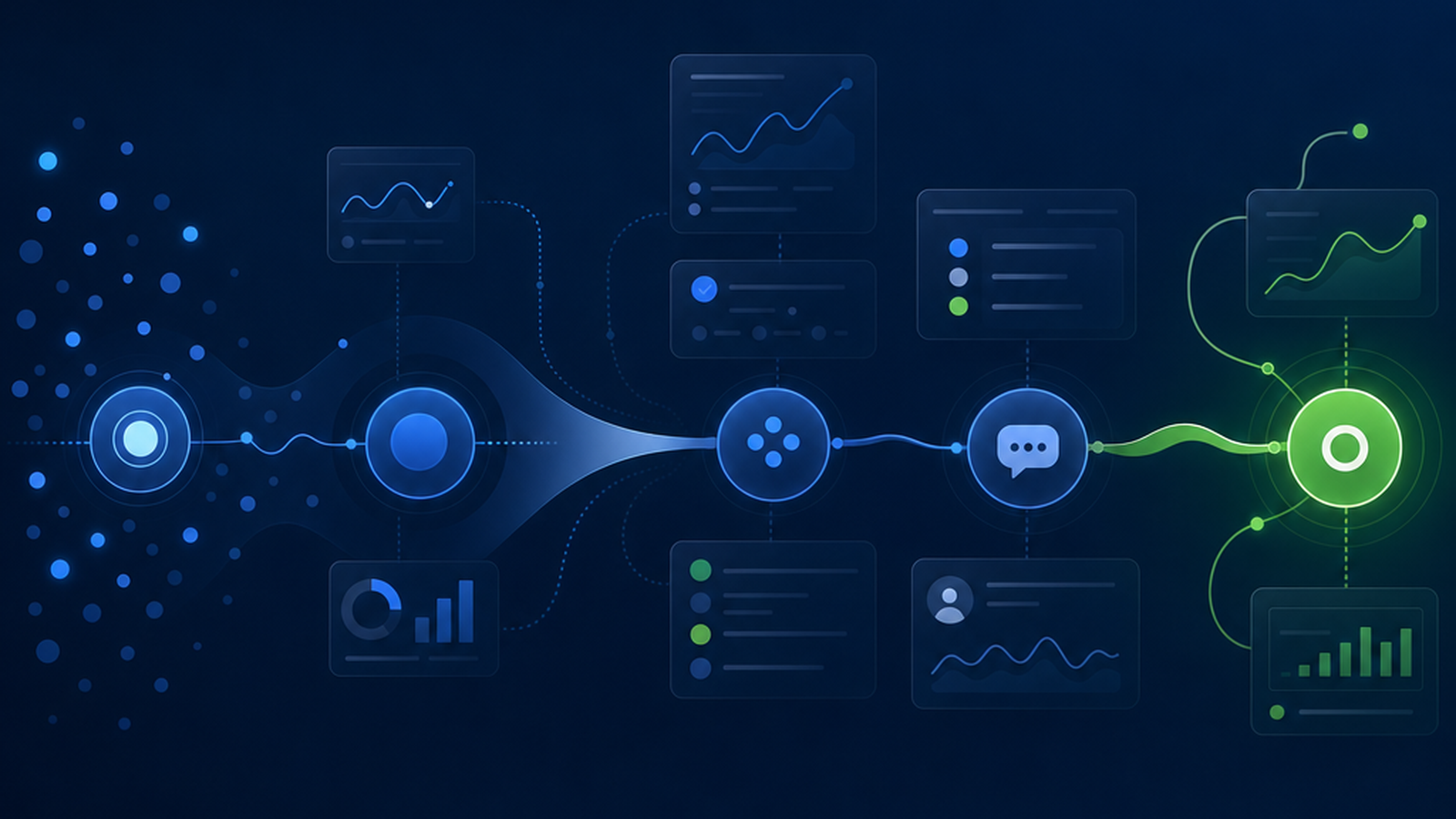
A useful measurement plan separates three levels:
Attention metrics
- Impressions
- Reach
- Clicks
- Search impressions & clicks
- Video views
Decision metrics
- Engaged sessions
- Scroll depth / key-content views
- Pricing-page visits
- Return visits
- Form starts
- Add-to-cart & checkout starts
Business metrics
- Generated & qualified leads
- Active sales conversations
- Closed customers
- Revenue & gross margin
- CAC and payback period
The purpose is not to create a dashboard with more numbers. It is to see where the decision is breaking. If traffic is low, solve reach or relevance. If traffic is strong but key pages are ignored, solve message-market fit or internal navigation. If forms start but do not finish, solve friction. If leads arrive but do not qualify, solve targeting and promise clarity. If qualified opportunities stall, solve proof, risk, follow-up, or sales handoff.
A practical 30-day messy-middle improvement plan
The real advantage is decision support
The brands that win the messy middle are not necessarily the brands with the biggest budgets. They are the brands that make the buyer's next question easier to answer. They show up when the buyer is exploring. They provide proof when the buyer is evaluating. They remove risk before the buyer has to ask. They measure the outcome beyond the click. And they use urgency, personalisation, and behavioural principles responsibly enough to preserve trust.
If your traffic looks healthy but leads or sales feel stuck, do not start by buying more traffic. Start by finding the unanswered question between the click and the conversion.
Growthbay helps businesses improve that full journey through SEO, Meta Ads, social media marketing, and Amazon growth support. Book a free audit or explore the Growthbay blog for more practical guides.
Stop losing buyers in the messy middle.
Growthbay builds conversion-focused marketing systems that connect attention to revenue — for service businesses, e-commerce brands, and Amazon sellers.
Related articles
[1] Google and The Behavioural Architects, Decoding Decisions: Making sense of the messy middle of purchase behavior. Used simulated, generic, unbranded purchase scenarios; treat as decision-science evidence, not a guaranteed performance benchmark. · [2] Google Analytics, GA4 Measurement Protocol event reference, last updated August 25, 2026. Confirm event names against the live property before publishing technical instructions. · [3] Google Search Central, AI features and your website. About eligibility and measurement, not a promise of inclusion in AI Overviews or AI Mode. · [4] Think with Google, The Messy Middle: How first-party data drives relevance in the AI era, March 2025. The 43% result comes from an Australian study of 2,500 in-market purchasers conducted in October 2024; not a universal conversion-rate uplift. · [5] web.dev, Largest Contentful Paint (LCP). · [6] web.dev, Interaction to Next Paint (INP). · [7] web.dev, Cumulative Layout Shift (CLS). · [8] HTTP Archive, 2024 Web Almanac: Performance, published November 11, 2024 and updated February 4, 2025. · [9] Baymard Institute, Cart Abandonment Rate, benchmark page listed as updated September 22, 2025. Figure is an average across 50 studies and is not a diagnosis of a particular checkout.