Your analytics show visitors arriving. Search impressions are rising. Perhaps paid ads, social media, referrals, or local search are sending hundreds or thousands of visits each month. But the phone is quiet, the contact form rarely produces a serious enquiry, and the leads you do receive are poor fits.
This is the frustrating gap between website traffic and business demand. A website can attract traffic without attracting people who have a meaningful reason, ability, or intention to buy. Even relevant visitors may leave when the offer is unclear, the page feels untrustworthy, the form is difficult, or the next step asks for too much too soon.
More traffic does not automatically solve this. It can simply amplify an existing conversion problem. If the wrong audience lands on a weak page, doubling traffic may double wasted attention and acquisition cost rather than qualified leads.
The solution is not to chase a universal conversion-rate benchmark. It is to identify where your specific journey breaks: acquisition, message match, persuasion, action, tracking, qualification, or follow-up.
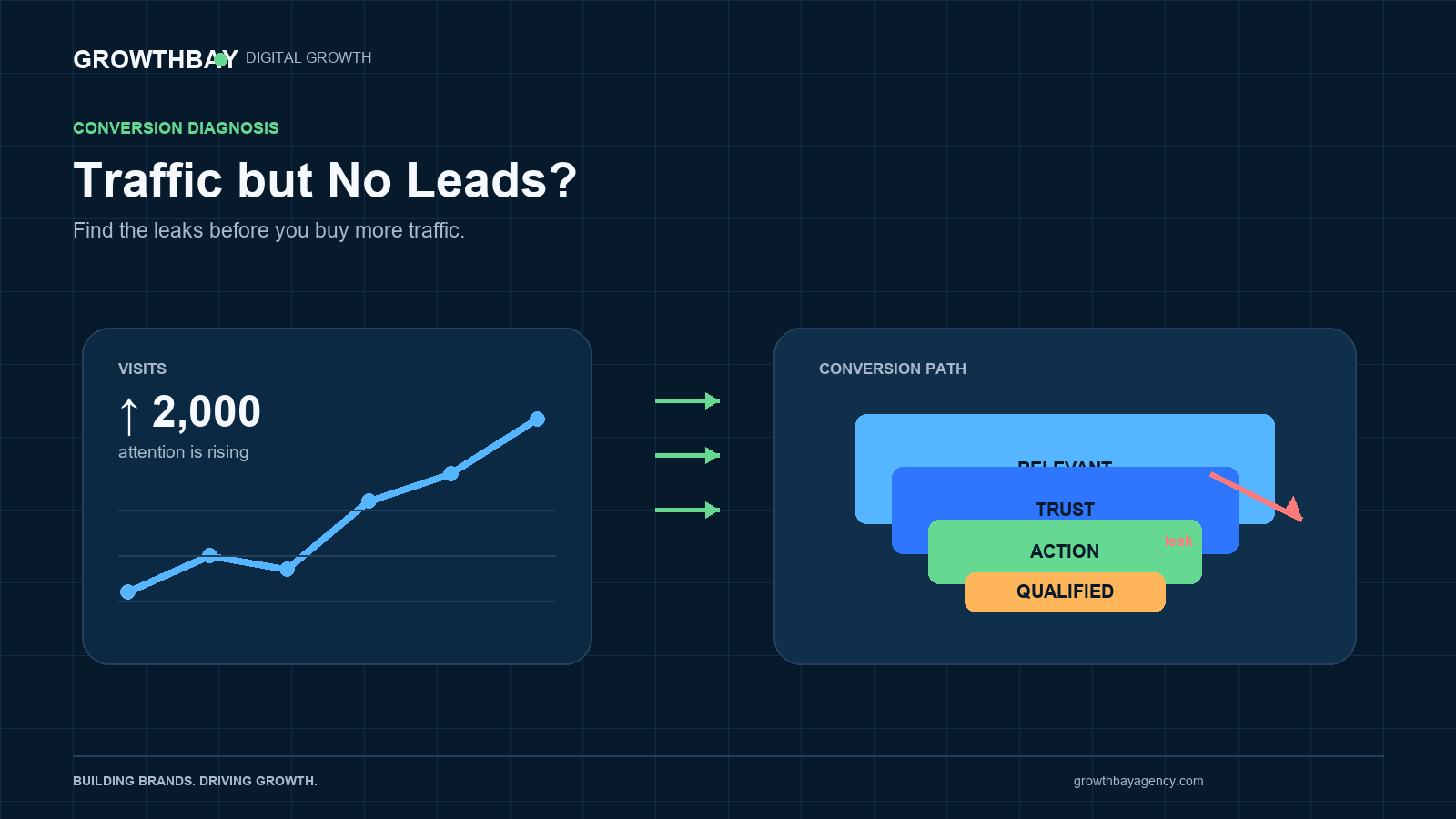
Start With the Difference Between Traffic and Qualified Demand
A visit is not a lead. A form submission is not necessarily a qualified lead. A qualified lead is not yet a closed customer. Those distinctions matter because headline traffic and submission numbers can hide a weak commercial outcome.
A blog post may attract students researching a topic. An ad may generate accidental mobile clicks. An ecommerce product page may attract comparison shoppers who are not ready to purchase. A local service page may rank outside the company's actual service area. Think about performance in layers:
- Relevant visit: the visitor fits the market and has a plausible need.
- Conversion: the visitor completes a defined action, such as requesting a quote.
- Qualified lead: the enquiry fits your service, location, budget, timing, or other criteria.
- Sales opportunity: your team confirms a genuine buying conversation.
- Closed customer: revenue is attributed to the opportunity.
Qualified leads = relevant visits × conversion rate × qualification rate
Illustrative example — not a benchmark:

15 Conversion Leaks That Cause Website Traffic but No Leads
1 You are measuring traffic quantity instead of traffic quality
A rise in traffic can come from an informational article, irrelevant international visits, referral spam, existing customers seeking support, job seekers, or a viral social post with no buying intent. Segment traffic by source, landing page, location, device, new versus returning visitor, and campaign. Then compare those segments using qualified leads and customers — not sessions alone.
Local example: A Manchester roofer may attract national traffic to an article about roof materials. Useful visibility does not mean those readers need a roof replacement within the company's service radius.
2 The page does not satisfy the visitor's search intent
Search intent describes what a person is trying to accomplish. If someone searches "emergency plumber near me," a general plumbing history page is a poor destination — they need service-area confirmation, availability, trust signals, and an obvious way to call. Map each important landing page to one dominant intent. If the page tries to educate beginners, compare alternatives, sell a premium service, and recruit employees simultaneously, it will usually serve none of those jobs particularly well.
3 Your channel promise and landing-page message do not match
An ad, search result, email, or social post creates an expectation. The landing page must continue the same conversation. If a Meta ad promotes a free consultation for independent retailers but sends users to a generic agency homepage, visitors must work to confirm that the offer exists and applies to them. Repeat the campaign's core promise, audience, and offer near the top of the destination page.
Businesses using paid social should review the connection between creative, audience, offer, and page. Growthbay's social media marketing and Meta Ads service is relevant when the acquisition campaign itself also needs diagnosis.
4 Your value proposition is too vague
Phrases such as "quality solutions," "customer-focused service," and "helping businesses grow" could describe thousands of competitors. A practical value proposition answers four questions quickly: who is this for, what valuable problem do you solve, what makes the approach credible or different, and what should the visitor do next?
Compare "We deliver innovative digital solutions" with "Conversion-focused websites for UK service businesses that need more qualified enquiries, not just more page views." Avoid unsupported superlatives — "best," "leading," and "number one" create scepticism unless you can substantiate them.
5 The offer does not match the visitor's stage or risk level
A visitor may want the outcome but reject the proposed next step. Asking a first-time visitor to commit to a long sales call or provide sensitive information can be disproportionate to their current trust. Create an offer ladder where appropriate:
Early stage
Checklist, guide, calculator, product comparison, or email update
Evaluation stage
Case study, sample, assessment, demo, or audit
High intent
Quote, consultation, booking, purchase, or call
Do not automatically add lead magnets to every page. A high-intent local visitor may simply need a phone number and fast booking. A six-month B2B purchase may need proof and education before a sales call.
6 The primary call to action is unclear
Pages often contain five competing actions: call, email, subscribe, follow, download, shop, and request a quote. When every action receives equal visual weight, the visitor has to decide what the business wants them to do. Choose one primary action for each page. CTA copy should describe the next step: "Request a roofing quote," "Book a product demo," or "Check delivery availability" is more informative than "Submit" or "Learn more."
7 Visitors cannot find enough trust or proof
Before handing over contact details, visitors assess whether you appear competent, legitimate, safe, and relevant. A polished design helps, but visual polish is not proof. Useful evidence includes specific testimonials naming the service and outcome, case studies explaining the starting point and result, relevant reviews from credible platforms, certifications or licences, real team or project photography, and transparent guarantees or policies. Place proof near the claim or point of anxiety it supports — a testimonial about response time belongs near the booking action.
8 The landing page has no persuasive sequence
A page can contain the right information in the wrong order. A strong service landing page will often follow this sequence:
- Audience, problem, outcome, and primary CTA
- Evidence that the business understands the problem
- Clear explanation of the service or solution
- Benefits and differentiators
- Proof, reviews, or a relevant case study
- Process, timeline, and what happens next
- Objection handling and FAQs
- Repeated CTA with appropriate contact options
This is not a mandatory template. A local emergency service may need a much shorter page. The principle is to answer questions in the order a buyer is likely to ask them.
9 Your form creates unnecessary friction
Every field creates effort and may raise a privacy or commitment concern. Ask only for information needed to respond, qualify, route, or price the enquiry at that stage. Use clear labels, sensible input types, visible validation, and a useful error message. On mobile, confirm that the keyboard type fits the field and the form does not reset after an error. Shorter is not always better — a specialist B2B provider may need a few qualifying fields to protect sales capacity. The goal is justified friction, not zero friction.
10 The mobile experience is slow, unstable, or hard to use
Test menus, buttons, cookie banners, forms, tap targets, text size, sticky elements, and click-to-call links on real devices. Google's current Core Web Vitals "good" thresholds, assessed at the 75th percentile, are: LCP of 2.5 seconds or less, INP of 200 milliseconds or less, and CLS of 0.1 or less. These are user-experience signals — good scores do not guarantee higher rankings or more leads, but they can remove avoidable frustration.
11 A technical failure blocks the conversion
Some conversion problems are not persuasive problems at all. The form may fail silently, CAPTCHA may reject valid users, emails may land in spam, a phone link may contain the wrong number, or a booking calendar may show no availability. Complete the journey yourself on mobile and desktop, submit test enquiries, verify confirmation delivery, and check that notifications reach the responsible person. Test after site updates, plugin changes, domain migrations, and CRM integrations.
12 Analytics count submissions but not lead quality
GA4's recommended event reference includes generate_lead and lead-status events such as qualify_lead, working_lead, and close_convert_lead. A triggered event does not prove that the person was qualified or became a customer. Use careful definitions, document criteria, prevent duplicate events, filter spam, connect CRM stages where feasible, and reconcile analytics with actual sales records.
13 You do not inspect what visitors do on the page
Aggregate analytics tell you where users entered and whether an event fired. Microsoft Clarity can help inspect clicks, scroll behaviour, session recordings, and detected interactions — smart events such as Contact Us, Submit Form, Request Quote, and Sign Up are available alongside custom events. Use this evidence to find patterns: repeated clicks on a non-clickable image, visitors missing a mobile CTA, abandonment at a particular form field. Recordings generate hypotheses, not causal proof. Validate suspected problems through testing and broader data.
14 Leads receive weak or slow follow-up
The website may be doing its job while the operating process loses the opportunity. Define who owns each lead type, how it is routed, the target response process during and outside business hours, and the follow-up sequence if the lead does not reply. An automatic confirmation should explain what happens next and expected response timing — it should not pretend that a human has already reviewed the enquiry.
15 Every channel is sent to the same generic page
Organic search, paid search, social media, referrals, email, and direct traffic create different levels of awareness and intent. Sending every visitor to the homepage often weakens relevance and measurement. Build dedicated destinations when the audience, promise, location, product, or offer materially differs. Avoid producing dozens of near-duplicate pages solely to target keywords — each page should have a clear user purpose and enough distinctive value to justify its existence.

Diagnose the Problem by Acquisition Channel
Before redesigning the website, compare patterns by channel.
Organic search
Review the queries and landing pages attracting impressions and clicks. Are they relevant to a service, location, category, or commercial problem? Informational traffic can support awareness, but it needs an appropriate path to a related service or next step. If relevant pages have weak visibility, start with technical and on-page fundamentals. Growthbay's SEO service and guide to SEO quick wins for service businesses provide useful next steps.
Paid search and paid social
Compare targeting, query or audience, ad promise, landing page, offer, and conversion tracking. High click-through rates can coexist with low lead quality. Exclude irrelevant searches or audiences and ensure the page repeats the specific proposition. Review the complete path — not the ad in isolation.
Organic social
Social traffic is often earlier-stage and mobile-heavy. Match the next step to that context. Educational posts may need a case study, guide, or product collection rather than an immediate high-commitment consultation. Consistent content and community management are separate from paid campaign optimisation. See Growthbay's social media management service when the wider organic programme needs work.
Referral, email, and direct traffic
Separate partner referrals, existing customers, employee visits, and untagged campaigns where possible. Use consistent UTM parameters for campaigns, but never place personally identifiable information in URLs.
For an ecommerce brand, diagnose product-view rate, add-to-cart behaviour, checkout progression, payment failures, and completed orders. A product advert may attract relevant shoppers, yet conversion remains weak because the landing page hides delivery costs, lacks size guidance, and defaults to an unavailable variant. The remedy is different from shortening a consultancy contact form.
Want Growthbay to find your conversion leaks?
We'll audit your acquisition, landing pages, tracking, forms, and follow-up in a free 30-minute session — and tell you the highest-confidence fix to make first.
A Practical 60-Minute Website Conversion Audit
You do not need a six-month redesign to locate the first problems. Use this focused audit to build a prioritised evidence list.
Minutes 0–10: Define the commercial outcome
Write down the primary action for each important page and define what makes a lead qualified. Record service area, minimum project requirements, excluded enquiries, and the CRM stage that represents a closed customer.
Minutes 10–20: Review acquisition and landing pages
In analytics and Search Console, identify the highest-traffic entry pages by channel. Mark each as relevant, partially relevant, or irrelevant to the offer. Note geographic and device anomalies. Do not assume the homepage is the main entry point.
Minutes 20–30: Run the five-second clarity test
Open each priority page on mobile and desktop. Can a new visitor quickly understand the audience, problem, outcome, proof, and next step? Compare the page with the search result, ad, email, or post that sends traffic.
Minutes 30–40: Complete every conversion path
Click calls to action and submit forms. Test validation, CAPTCHA, booking availability, confirmation messages, inbox delivery, CRM creation, and analytics events. For ecommerce, complete a test order where operationally possible.
Minutes 40–50: Inspect behaviour and experience
Check page speed and Core Web Vitals, then use analytics and tools such as Clarity to review scrolls, clicks, and recordings. Look for repeated friction rather than reacting to one unusual session.
Minutes 50–60: Review lead handling and choose priorities
Trace recent enquiries from submission to final outcome. Score identified issues by potential impact, confidence in the evidence, and implementation effort.

How to Prioritise Conversion Fixes
Do not begin with cosmetic preferences. Prioritise issues using three factors:
Impact
How close is the issue to an important commercial action, and how many relevant visitors encounter it?
Confidence
Is the issue supported by failed tests, analytics, customer feedback, recordings, or sales data?
Effort
How much development, design, copy, approval, or operational work is required?
Fix definite failures first: broken forms, wrong phone numbers, unavailable calendars, missing notifications, duplicate tracking, and unusable mobile layouts. Then address high-confidence relevance and persuasion problems. Treat colour changes and subjective redesign ideas as lower priority unless evidence supports them.
Change one major variable at a time when practical, annotate deployments, and compare qualified leads and customers — not only button clicks. Small businesses with limited traffic may not reach reliable experiment sample sizes quickly. Combine quantitative data with usability checks, sales feedback, and structured before-and-after monitoring without claiming statistical certainty.
A 30-Day Plan to Generate More Qualified Leads
Days 1–5: Repair measurement and technical failures
- Define relevant visit, enquiry, qualified lead, working lead, and closed customer
- Test every form, phone link, booking tool, inbox, CRM route, and confirmation
- Verify important events in GA4 Realtime and prevent obvious duplication
- Create a basic source-to-lead-to-customer report
- Record the current baseline
Days 6–10: Improve traffic relevance and message match
- Review top landing pages, search queries, campaigns, locations, and devices
- Exclude clearly irrelevant paid targeting where appropriate
- Align page headlines with the source promise and visitor intent
- Add clear paths from informational content to relevant commercial pages
- Stop funding channels that cannot be connected to meaningful outcomes until tracking is repaired
Days 11–15: Strengthen the offer and page copy
- Rewrite vague headlines around audience, problem, and outcome
- Choose one primary CTA per page and make the wording specific
- Match the offer to the visitor's likely buying stage
- Explain process, scope, timing, and what happens after contact
- Add objection handling without burying the main proposition
Days 16–20: Add proof and reduce friction
- Place relevant testimonials and case studies near important claims
- Add legitimate credentials, policies, company information, and real imagery
- Remove unjustified form fields and improve validation
- Test mobile usability on multiple devices
- Address the most obvious speed, stability, and interaction problems
Days 21–25: Build the follow-up system
- Assign ownership for each enquiry type
- Create useful internal alerts and customer confirmations
- Establish response and follow-up procedures
- Add consistent qualification and loss-reason fields in the CRM
- Train the team to update stages rather than leaving every submission labelled "new lead"
Days 26–30: Launch the first controlled improvements
- Select the highest-impact, highest-confidence page for improvement
- Document what changed and why
- Monitor technical operation, relevant visits, submissions, qualified leads, and sales outcomes
- Review Clarity and customer feedback for new friction signals
- Build the next backlog based on evidence rather than declaring the website "finished"
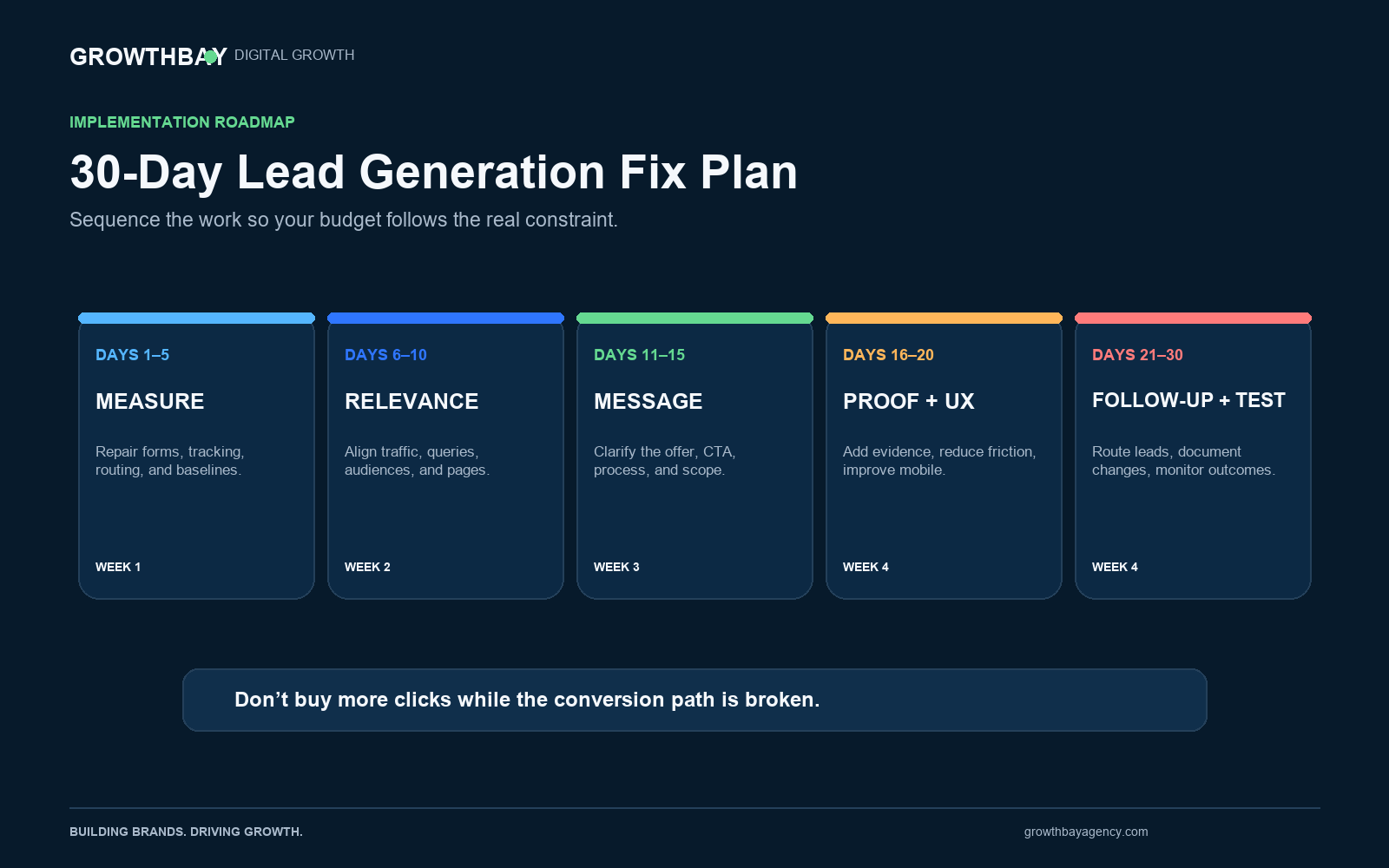
There is little value in buying more clicks while forms fail or follow-up is unmanaged. Growthbay's guide to building a small-business digital marketing budget can help allocate resources, while the digital marketing funnel guide provides a broader view of the customer journey.
Frequently Asked Questions
Turn Traffic Into a Measurable Lead System
If your website gets traffic but no leads, resist the urge to start with a full redesign or another traffic campaign. First determine whether the right people arrive, whether the page matches their intent, whether they trust the offer, whether the action works, and whether your team converts enquiries into genuine sales conversations.
Growthbay Agency can audit the complete path across acquisition, landing pages, tracking, qualification, and follow-up. Book a free 30-minute audit to discuss your website's conversion gaps.
Stop losing leads from traffic you're already paying for.
Growthbay audits the complete conversion path — from acquisition and landing pages to forms, tracking, and follow-up — and tells you exactly what to fix first.
Related articles
Google Analytics — Measure lead-form submissions. A recorded submission confirms an event was captured; it does not establish that the lead was qualified or became a customer. · GA4 recommended events — generate_lead, qualify_lead, working_lead, close_convert_lead. Event names only become meaningful when implemented correctly and tied to documented business-stage definitions. · Google Web Vitals (web.dev) — LCP ≤2.5s, INP ≤200ms, CLS ≤0.1 at 75th percentile. Good scores do not guarantee rankings, conversions, or lead growth. · Google Search Central — Core Web Vitals should not be presented as the sole ranking factor or as a substitute for relevance and useful content. · Microsoft Clarity FAQ — Clicks, recordings, and detected events can reveal patterns but do not independently prove why a user behaved in a particular way. · HubSpot — Website lead-generation guide. Illustrative conversion comparisons are not universal benchmarks or expected results. · Baymard Institute — Checkout usability research. Findings concern ecommerce checkout journeys and should not be generalised to service-business contact forms.